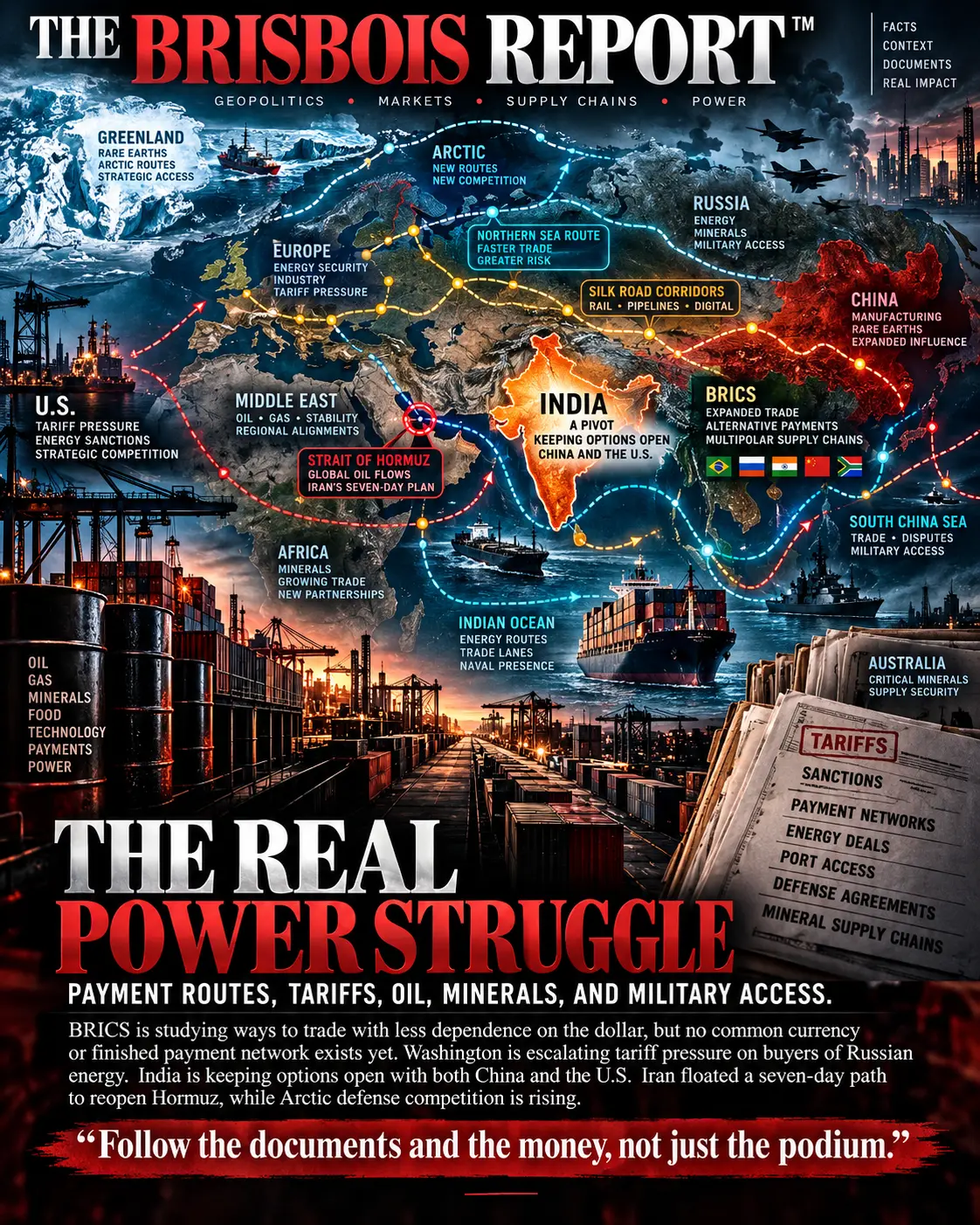
The short version: BRICS is studying ways to make cross-border payments easier, Washington has enacted tariff authority tied to Russian energy, Iran proposed a path to reopen Hormuz that Trump rejected, and the United States signed an Arctic defense deal with Denmark and Greenland. These are different kinds of action. None proves the world order changed overnight. Together, they show governments fighting for backup routes and leverage.
All is good in my world.
No, it ain’t. Say it again. No, it ain’t.
The headlines want your eyes on the podium. One leader threatens. Another promises unity. The cameras get their clip, the algorithms get their fight, and the public gets another reason to be scared.
Meanwhile, the machinery keeps moving.
How does a company get paid across a border? Who can buy the oil? Which country can threaten a tariff on the buyer? Who controls access to a shipping route? Who gets to invest in the minerals beneath Greenland? Those questions sound boring until you realize they decide who has leverage when the shouting stops.
So let’s cut through the bullshit and follow the machinery.
New Delhi: a BRICS payment blueprint, not a finished bypass
At the BRICS summit in New Delhi on September 12–13, the leaders did not launch a common currency. They did not announce that India’s UPI, Brazil’s Pix, Russia’s MIR, and China’s CIPS had been connected into one working BRICS Pay network. The New Delhi Declaration says the BRICS Payment Task Force studied how national payment and messaging channels might work together. It calls for continued talks on cross-border payments and discusses using local currencies for trade and investment.
Read those verbs again: studied, discussed, encouraged. A blueprint matters, but it isn’t a completed bridge. If somebody tells you the dollar was overthrown last weekend, they’re selling a movie trailer as a documentary.
The serious part is the direction of travel. The declaration supports more payment options, development financing, and a larger voice for emerging economies in the IMF and World Bank. It calls for mineral supply chains that give resource-rich countries more value. Those are goals, not proof of a working new system.
Let’s keep our heads: the dollar still represented 57.13% of reported global foreign-exchange reserves in the first quarter of 2026, according to the IMF. That is a reserve-currency measure, not a count of every trade payment. You don’t erase a financial system that deep with a summit paragraph. But you can try to make yourself less dependent on its chokepoints, one transaction, one lender, one trade corridor at a time.
That is the real contest. Optionality.
Washington’s tariff gun has a real trigger
Six days after the declaration was adopted, Trump signed the Lindsey O. Graham Sanctioning Russia and Iran Act of 2026. Section 113 directs duties of up to 100% on goods imported from countries that meet specified conditions related to new purchases of Russian oil or gas or to facilitating Russian oil sanctions evasion. The law focuses on the five largest importers or top five facilitators under its defined tests. It sets timing, documentation, later determinations, and a limited natural-gas exception.
That is a hell of a weapon. It is also not a blanket 100% tariff on every BRICS member for attending a summit. The statute targets defined conduct, not a country’s BRICS membership. Getting that straight makes the argument stronger, because the actual law is more consequential than a made-up sound bite.
The enacted authority and tariffs actually imposed are separate questions. The administration must apply the statutory tests and determine countries and rates. Watch the written justifications and exceptions. The law can change negotiating leverage before a new duty takes effect.
The strategic tension is obvious. Washington wants to preserve leverage over trade and energy flows. Other capitals want ways to keep trading when Washington reaches for that leverage. You can support pressure on Russia over Ukraine and still ask what happens when tariffs become a lasting feature of diplomacy. Every government will calculate the answer in its own interest.
India is the tell, but it isn’t anybody’s property
Modi and Xi met in New Delhi on September 12. According to India’s official readout, they discussed business links, market access, supply chains, and their unresolved boundary question. That meeting was real. So were the differences they acknowledged.
Now look west. Washington and New Delhi set a goal of $500 billion in annual bilateral trade by 2030 in their February 2025 leaders’ statement. A separate February 2026 framework describes the next steps toward a U.S.–India trade agreement. The $500 billion figure is a target, not today’s trade volume, and it says nothing about India secretly killing a BRICS currency proposal.
India can repair ties with China, work inside BRICS, seek energy supplies, and negotiate hard with the United States. That is my inference from the agreements and meetings, not a claim that India has chosen a permanent camp. The power play is to keep doors open while everybody else demands loyalty.
When a large country refuses to become somebody else’s piece on the board, pay attention.
Hormuz: the bill for a blocked waterway
On September 25, Iranian Foreign Minister Abbas Araghchi said at the United Nations that Tehran had sent Washington, through Qatar, a plan under which the Strait of Hormuz could reopen within seven days if its conditions were met. Associated Press reporters at the UN reported conditions involving an end to the U.S. naval blockade of Iranian ports, oil-sanctions relief, and a ceasefire including Lebanon. AFP reported a demand for access to at least $12 billion in frozen assets. That financial term comes from the reporting; it was not itemized in the minister’s brief public explanation of the timetable.
On September 26, Trump told reporters he had rejected Iran’s proposal. So there is no deal. There is a proposed sequence, reported demands, and a waterway whose disruption reaches far beyond the countries firing at each other.
Don’t reduce that to a clever oil trade. Real people have died in this war. But don’t pretend energy security sits outside the negotiations, either. When ships cannot move reliably, the pressure shows up in fuel, freight, insurance, and household bills thousands of miles away. A chokepoint can carry more negotiating power than a hundred speeches.
Greenland: read the signed paper
On September 22, the United States, Denmark, and Greenland signed an Arctic defense agreement. It provides for a larger U.S. military presence, including defense areas at Narsarsuaq and Mestersvig, with technical details to be agreed by the parties. It also calls for screening certain foreign investments in sensitive sectors, a category that includes resource extraction. The signed text recognizes mineral cooperation. It does not transfer title to Greenland’s minerals to the United States.
It reaffirms Danish sovereignty and Greenlanders’ right to self-determination. Greenland signed as a party. The agreement takes effect only after the necessary parliamentary procedures. It also favors Greenlandic sources for defense-area contracts where feasible.
Those details matter. Defense access, investment screening, contracts, and ownership are different things. Calling them the same buries the story under its own bullshit.
Put it next to BRICS language on critical minerals: tomorrow’s industry depends on land, access, processing, security, and who gets a seat at the table. That is a connection between two documents, not a joint plan.
The bank loan that tells the truth about scale
The New Development Bank’s board approved up to $200 million for a South African water project on September 16–17. A separate $1 billion municipal water loan was approved on August 29, 2024, for a 15-year term. It was not a new September 2026 deal.
I bring up that correction for a reason. Development lending outside the older Western-led institutions is real. A bank doesn’t need to replace the World Bank tomorrow to give a borrower another phone number to call. But calling an old loan a new breakthrough is how analysis turns into fan fiction.
What the headlines miss
Governments want backups: another payment route, lender, energy supplier, security agreement, or mineral buyer. Some will work. Some will die in committee. Some will create new dependencies.
Here is the scorecard I will use after the speeches end:
- Payments: Does the BRICS task force produce a live, usable arrangement with published rules and measurable volume?
- Tariffs: Which countries and rates are actually named under the U.S. law, and how are the tests justified?
- India: Do talks with China produce durable market access and border stability while U.S.–India negotiations continue?
- Hormuz: Can commercial ships transit reliably, and do the parties publish and implement an agreement?
- Greenland: Do the parliamentary procedures finish, and what defense, investment, and contracting decisions follow?
If somebody tells you the dollar dies next Tuesday, ask for the receipts. If somebody tells you nothing is changing, ask why the biggest powers on earth are wrestling over the pipes.
The people at the top would love for the rest of us to live on fear, tribal loyalty, and a steady diet of headlines. Screw that. Learn how the system works. Question your own side as hard as the other one. Build skills, protect your household from debt and price shocks, and keep your judgment when the room gets loud.
Frequently asked questions
Did BRICS launch a common currency in September 2026?
No. The New Delhi Declaration discusses local-currency trade and payment interoperability, not a common currency. Implementation requires further work.
Is there a working BRICS Pay network connecting UPI, Pix, MIR, and CIPS?
The declaration reports studies and continued talks by the BRICS Payment Task Force. A completed network would need operating rules, participating institutions, and transaction data.
Has the United States imposed a 100% tariff on every BRICS country?
No. Section 113 concerns specified Russian-energy purchases or sanctions evasion, with duties up to 100% and a defined exception. BRICS membership is not the trigger.
Did India choose China over the United States?
The Modi–Xi meeting addressed unresolved issues. The U.S.–India trade framework remains in place. Together, they suggest India wants room to bargain with both.
Did Iran and the United States reach a deal to reopen Hormuz?
No. Iran offered a conditional seven-day sequence through Qatar, and Trump said on September 26 that he rejected it. That is not an implemented agreement.
Did the United States acquire Greenland or its minerals?
No. The agreement expands potential defense access and investment screening. It affirms sovereignty and self-determination, transfers no mineral ownership, and awaits parliamentary procedures.
Why does the New Development Bank’s loan date matter?
They are two different approvals: up to $200 million for the Olifants project in September 2026, and $1 billion for municipal water in August 2024. The older loan had a 15-year term.
Follow the documents
The BRICS payment debate is about practical options. The tariff law’s application needs watching. Hormuz remains contested. Greenland signed a consequential agreement with its rights written into the paper. Follow transactions and implementation, not just declarations.
We stand as one without surrendering our minds to one voice. We follow the money. We read the documents. And we decide for ourselves.
THE BRISBOIS REPORT™
No Spin. No Filter. No Bullshit.